15 April 2026 · Monitors · AI-assisted · published by Jaco Olwagen · How we rank
Best Gaming Monitors Australia 2026: 1440p Picks for Every Budget
The best gaming monitors in Australia for 2026 - from budget 1440p IPS panels to Mini LED with HDR 1000. All on Amazon AU with prices in AUD.
Best Gaming Monitors Australia 2026: 1440p Picks for Every Budget
If you're still gaming on a 1080p 60Hz panel in 2026, you're leaving real performance on the table. The good news: 1440p has become the undisputed sweet spot for PC gaming, and the prices on some genuinely excellent 27-inch panels have dropped to a point where upgrading makes clear sense. Head to our monitors category and you'll see what we mean - there's a wide range on offer for Australian buyers right now.
Whether you've just picked up an RTX 5070 and want a display that can actually push it, or you're running an older rig and want more screen real estate without 4K crushing your GPU, the monitors on this list cover you from budget 1440p IPS panels up to 180Hz Mini LED with HDR 1000. They're all on Amazon AU, they're all in stock, and they suit different use cases. Here's what you need to know.
Quick Picks - Best Gaming Monitors in Australia 2026
| Monitor | Best For | Price (AUD) |
|---|---|---|
| GIGABYTE M27Q | Best budget 1440p | ~A$279-349 |
| LG 27GP850 | Best overall mid-range | ~A$429-499 |
| AOC Q27G3XMN | Best Mini LED under $600 | ~A$499-549 |
| Samsung Odyssey G7 27" | Best curved 240Hz | ~A$479-549 |
What to Look for in a Gaming Monitor in 2026
Resolution: 1440p Is the Sweet Spot
4K gaming is still GPU-hungry. Unless you're running a top-tier card like an RTX 5080, you'll be trading frame rates to hit 4K at high settings. 1440p (2560 x 1440) delivers noticeably more detail than 1080p on a 27-inch screen without demanding nearly as much from your graphics card. It's the resolution most PC gamers - from casual players to enthusiasts - have landed on, and it's easy to see why.
Refresh Rate: 165Hz Is the New Baseline
60Hz feels slow once you've used 144Hz. In 2026, the entry point for proper gaming monitors is 165Hz. If you're into competitive games like CS2, Valorant, or Apex Legends, 240Hz is worth chasing. For single-player games and general PC gaming, anything above 144Hz is comfortable and you'll notice the fluidity every time you move the mouse. The jump from 165Hz to 240Hz is real but meaningfully smaller than the leap from 60Hz to 144Hz.
Panel Type: IPS vs VA vs Mini LED
IPS panels have better colour accuracy and wider viewing angles - they look good for gaming and for colour-sensitive creative work. VA panels have better contrast ratios and deeper blacks, which shows in dark game environments. Mini LED takes an IPS or IPS-type panel and adds a grid of tiny LED backlights with local dimming zones, giving you something much closer to OLED-level contrast without the burn-in risk. For the money, IPS hits the best all-round balance. Mini LED costs more but delivers HDR performance that's actually visible.
Response Time: GtG vs MPRT
Monitor specs quote either GtG (Grey-to-Grey) or MPRT (Moving Picture Response Time) - and they're not the same thing. GtG is the real-world pixel transition time. MPRT is measured with backlight strobing enabled and looks impressive on paper (0.5ms or 1ms), but requires brightness reduction to achieve it. The practical difference for gaming is minimal unless you're highly sensitive to motion blur. Most gaming monitors in this price range are fast enough that response time isn't a real bottleneck.
GIGABYTE M27Q - Best Budget 1440p Gaming Monitor
 GIGABYTE M27QCheck Price
 ~A$279-349 on Amazon AU
The GIGABYTE M27Q is the monitor you buy when you know what you want and don't want to overpay for it. It's a 27-inch 1440p IPS panel running at 165Hz with a KVM switch built in - which sounds like a niche feature until you're flipping between a work PC and a gaming rig without unplugging anything. For remote workers who run two machines through one screen, it's genuinely practical and removes the need for a separate KVM box.
The panel uses GIGABYTE's SS IPS (Super Speed IPS) technology with 0.5ms MPRT response time and 92% DCI-P3 colour coverage. Colour accuracy is solid for the price - the wide colour gamut makes games look vivid without being artificially oversaturated. FreeSync Premium is on board, and it's also G-Sync Compatible, so it plays nice with both AMD and NVIDIA setups without needing to buy the G-Sync tax.
Two USB 3.0 ports on the back handle keyboard and mouse passthrough for the KVM. For a monitor at this price, that's a practical inclusion you'd normally pay extra for. The stand is tilt-only on the base model, which is the obvious cost-cutting compromise - pair it with a cheap VESA arm if you need height adjustment and it becomes a non-issue.
The good: 165Hz 1440p IPS, 92% DCI-P3, built-in KVM switch, FreeSync Premium plus G-Sync Compatible, competitive price point.
The trade-off: Base stand is tilt-only with no height adjustment, HDR is nominal rather than meaningful, it's a few years old now and newer models are pushing up around it.
LG 27GP850 - Best Overall Mid-Range
 LG 27GP850Check Price
 ~A$429-499 on Amazon AU
The LG 27GP850 is the monitor that keeps appearing at the top of enthusiast recommendation lists, and it's earned that reputation. It's a Nano IPS panel with a rated 165Hz refresh rate that overclocks to 180Hz, and it hits all the right numbers at a price that doesn't sting. LG's Nano IPS technology uses nanosized particles to widen the colour gamut over standard IPS - the result is 98% DCI-P3 coverage and colours that look natural and accurate rather than punchy for punch's sake.
VESA DisplayHDR 400 certification is here, which means it can hit 400 nits peak brightness with proper HDR content. It's not transformative HDR, but it's legitimate. 1ms GtG response time. G-Sync Compatible and FreeSync Premium. The stand has full ergonomic adjustment - height, tilt, and pivot - which matters if you're sitting in front of it for long stretches at a desk in Brisbane in January.
The 27GP850 has been around a few years and is now at a comfortable price for what it delivers. It doesn't have the Mini LED contrast of the AOC further up the list, and it's not 240Hz. But if you want a fast, accurate, well-built 1440p gaming monitor with headroom to overclock and a brand you trust, this is the sensible mid-range pick. The 98% DCI-P3 coverage also makes it comfortable for creative work alongside gaming - photographers and video editors who also game will appreciate it.
The good: Nano IPS with 98% DCI-P3, 165Hz plus 180Hz overclock, 1ms GtG, full ergonomic stand adjustments, G-Sync Compatible, excellent colour accuracy.
The trade-off: HDR 400 is modest compared to the AOC's HDR 1000, no Mini LED local dimming, showing its age against more recently released monitors at a similar price.
AOC Q27G3XMN - Best Mini LED Under $600
 AOC Q27G3XMNCheck Price
 ~A$499-549 on Amazon AU
Mini LED is what happens when panel engineers try to deliver OLED-level contrast without the burn-in risk or the OLED price tag. The AOC Q27G3XMN uses a Mini LED backlight with local dimming zones to achieve HDR 1000 peak brightness - 1,000 nits certified, which is a number that actually changes how a game looks rather than just appearing on a spec sheet. Dark scenes go genuinely dark. Bright highlights push through. It's the kind of HDR performance that makes you reconsider games you thought you knew.
The core specs are strong: 27 inches, 2560 x 1440, 180Hz, 1ms GtG. Colour coverage sits at 137.5% sRGB, and the local dimming zones manage contrast across different parts of the frame simultaneously. In games that shift between bright outdoor environments and dark interiors - think horror games, shooters with night maps, anything with strong lighting contrast - the difference is visible compared to a standard IPS panel.
AOC includes a three-year Zero Bright Dot warranty, which is worth calling out when you're spending over $500 on a monitor - it signals confidence in panel quality that budget brands tend not to offer. The monitor is also Xbox, PS5, and Switch compatible via HDMI 2.0, so it doubles as a console display without adapters.
The honest caveat: Mini LED local dimming can produce a subtle "blooming" halo effect around bright objects on very dark backgrounds - this is common across Mini LED monitors. User reports on the Q27G3XMN suggest it's well-controlled compared to earlier Mini LED implementations, but it exists if you're looking closely at high-contrast scenes.
The good: HDR 1000 Mini LED with local dimming, 180Hz, 1ms GtG, 3-year Zero Bright Dot warranty, genuine high-contrast HDR performance you'll actually notice.
The trade-off: Minor blooming possible in extreme contrast scenes (a Mini LED characteristic, not unique to this model), costs more than standard IPS options, HDR content is needed to show its real advantage.
Samsung Odyssey G7 27" - Best Curved 240Hz
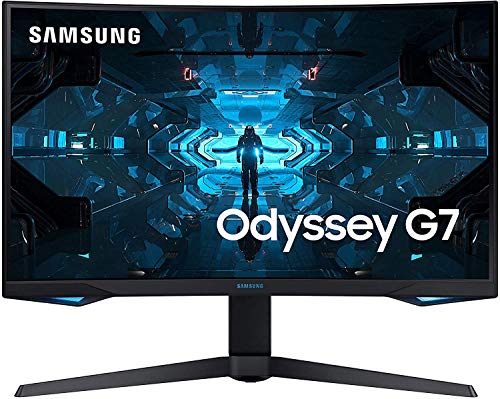 Samsung Odyssey G7 27"Check Price
 ~A$479-549 on Amazon AU
The Samsung Odyssey G7 is for anyone who's settled on a curved display and wants the highest refresh rate on this list. The 1000R curve is tight - tighter than most curved monitors - and it either clicks for you or it doesn't. People who game close to the screen tend to find it immersive; those who sit further back or use the same screen for work can find the curve distracting for documents and straight lines. Worth figuring out which camp you're in before buying.
What the G7 does well without argument: 240Hz on a 1440p VA panel. VA panels have better native contrast than IPS, and the G7's contrast ratio makes dark in-game environments look genuinely deep in a way that flat IPS monitors at this price point don't match. G-Sync Compatible and FreeSync Premium Pro. Samsung's DisplayHDR 600 certification means it hits 600 nits peak - a meaningful step above HDR 400 and usable for HDR gaming, short of the AOC's HDR 1000.
For competitive gaming, 240Hz is where you want to be if the budget stretches. The G7 delivers that frame rate ceiling with Samsung's reliability and the added immersion of the 1000R curve. If esports titles are your primary use and you sit reasonably close to your desk, this is the pick for raw frame rate performance.
The good: 240Hz refresh rate, 1000R curved immersion, strong VA contrast, FreeSync Premium Pro plus G-Sync Compatible, Samsung build quality, DisplayHDR 600.
The trade-off: VA response can show trailing in some fast transitions (check if this bothers you), the tight 1000R curve is not suited to multi-monitor setups or heavy productivity use, heavier than IPS alternatives.
Comparison Table
| Monitor | Resolution | Refresh Rate | Panel | HDR Cert | Price (AUD) |
|---|---|---|---|---|---|
| GIGABYTE M27Q | 1440p | 165Hz | SS IPS | HDR Ready | ~A$279-349 |
| LG 27GP850 | 1440p | 165Hz (180Hz OC) | Nano IPS | HDR400 | ~A$429-499 |
| AOC Q27G3XMN | 1440p | 180Hz | Mini LED IPS | HDR1000 | ~A$499-549 |
| Samsung Odyssey G7 | 1440p | 240Hz | VA Curved | HDR600 | ~A$479-549 |
Frequently Asked Questions
Is 1440p worth it over 1080p for gaming in 2026?
On a 27-inch display, the jump from 1080p to 1440p is significant - you go from 93 pixels per inch to 109 pixels per inch, which means sharper text, cleaner game textures, and a screen that doesn't look soft when you're sitting close. Most mid-range GPUs from 2022 onwards handle 1440p gaming comfortably at high settings. If your GPU is from the RTX 3000 or RX 6000 series or newer, 1440p is the right resolution to pair with it.
What GPU do I need for 1440p 165Hz gaming?
As a rough guide: an RTX 4070, RTX 5060 Ti, or AMD RX 7800 XT and above will drive 1440p at high settings in most titles at or near 165Hz. Demanding games like Cyberpunk 2077 at maximum settings may need frame generation (DLSS 4 or FSR 4) to hit consistent high frame rates. All the monitors on this list support variable refresh rate via FreeSync or G-Sync, so the actual frame rate doesn't need to be perfectly locked - the monitor syncs to whatever your GPU delivers within its supported range.
Is Mini LED worth the extra cost over standard IPS?
It depends on how often you actually use HDR content. If you play HDR-enabled games or watch HDR video through your PC regularly, the AOC Q27G3XMN's HDR 1000 certification produces a viewing experience that's visibly different from HDR 400 monitors. If you game exclusively in SDR, the Mini LED advantage is smaller - though the local dimming still improves contrast even in SDR. At $499-549, it's around $70-100 more than the LG 27GP850. Worth it if HDR is a priority; less compelling if you rarely toggle it on.
Curved or flat?
Curved monitors are genuinely divisive. The 1000R curve on the Samsung Odyssey G7 is aggressive - built for immersive gaming, less suited to multi-monitor setups or productivity tasks with lots of straight lines. If gaming is the primary use and you sit around 60-80cm from the screen, you might appreciate it. If you're mixing gaming with spreadsheets, documents, and creative work, a flat IPS monitor like the LG 27GP850 or GIGABYTE M27Q is the less contentious choice.
Which Gaming Monitor Should You Buy?
For most Aussie gamers after a solid 1440p upgrade without spending $500-plus, the GIGABYTE M27Q at $279-349 on Amazon AU is a sensible buy. The KVM switch and 165Hz IPS panel cover most use cases, and the colour coverage at 92% DCI-P3 is above average for the price bracket.
If you want the monitor most enthusiasts point to as the best value for quality, the LG 27GP850 is the answer. Nano IPS, 98% DCI-P3, 180Hz when overclocked, and full ergonomic adjustments. Around $429-499 on Amazon AU.
Bump up to the AOC Q27G3XMN if HDR 1000 Mini LED is the spec you're chasing. It's the only monitor on this list that delivers HDR you'll actually notice, with a three-year warranty to back the investment.
And for competitive gamers who want 240Hz and can live with - or actively prefer - a curved VA panel, the Samsung Odyssey G7 delivers the highest frame rates here with Samsung's proven reliability.
For more on monitors, check out our 4K vs 1440p comparison if you're still deciding on resolution, our best budget 4K monitors guide for anyone pushing into UHD territory, or our USB-C monitor guide if you're after single-cable connectivity for a MacBook or laptop. Browse our full monitors category for the complete picture on what's available to Australian buyers right now.
Top Picks - Check Latest Prices


See Our Top 7 Monitors for Australia
Hand-picked and ranked by our editors — with honest pros, cons, and Aussie pricing.
More Monitors Reading
Best Monitor Light Bar Australia 2026 - 7 Picks From A$54 to A$289
Best monitor light bar Australia 2026: 7 picks with live Amazon AU prices, from a A$54 Baseus i-Wok to the A$289 BenQ ScreenBar Halo 2.
Best Ultrawide Monitor Australia 2026: 7 Picks From Budget to QD-OLED
Best ultrawide monitor Australia 2026: 7 picks from a sub-$400 curved workhorse to 49-inch QD-OLED and 5K2K Thunderbolt, all on Amazon AU.
Best 4K Monitor Under $500 EOFY 2026 Australia - Seven Tax-Friendly Picks
Best 4K monitor under $500 EOFY 2026 Australia. Seven sub-A$500 picks on Amazon AU for sole traders and WFH workers buying before 30 June.
Weekly AU tech deals, in your inbox
We check prices on every product we cover daily. Once a week we send the biggest genuine price drops we spot - the ones worth your attention.
- One email a week, max
- No spam, ever
- Unsubscribe in one click